

Most economists assume that humans/ consumers are machines that can instantly choose their demand for products and can make rational choices to maximise their utility. They assume that consumers don’t consider other factors. This assumption is known as the concept of ‘Homo Economicus’. The main argument from behavioural economists is that consumers actually DO take in other factors. They argue that humans are not machines, they are not abnormally rational and do have limits to rational decision making. They look further than simple economic ideas and try to understand how consumers behave in order to increase their profits.
Arguably one of the most famous behavioural economists is Herbet Simon who stated that there are many various constraints, such as memory constraints or cognitive constraints, that limit our strategies. He believed that consumers would not be able to have access to all the information required to make the optimal decision, but even if they could have all the information, they would not be able to process it all. The human mind restricts itself. He talked about ‘satisficing’ decision making, which means that while consumers are out shopping, they may choose products that are acceptable rather than the optimal decision. Herbet Simon also brought the idea of heuristics. A heuristic is a technique that people use to help them make a decision or solve a problem quickly. We often use the phrase rule of thumb to mean the same thing. These methods may come from previous experiences (memory).
For e.g., a consumer with the name Bob chose to drive to Tesco to buy a potato rather than to go to Waitrose. This is because Bob may have known that onions are cheaper in Tesco and assumed that potatoes would also be cheaper. This led to the consumer making a quick simple decision (Tesco instead of Waitrose) from using information from past experiences rather than spending a lot of time to research the prices and quality of the potatoes from both firms.
Bounded rationality implies that humans take shortcuts in order to make the quickest and most simple decision as they are lazy thinkers. Economists such as Cass Sunstein and Richard Thaler developed ‘Nudge Theory’. Richard Thaler uses Herbet Simon’s theories of choosing what is easier rather than smarter to develop new ideas in architectural positioning of products. One of the ideas he pushed forward was to change shelf positioning to nudge consumers to increase consumption for healthy positive foods (Framing). By putting merit goods, such as salads, at eye level, consumers tend to pick that over cookies or pizza that are at the bottom of the shelf. These shelving tactics use the simplistic and easy option thinking from humans to benefit the consumers. Nudge techniques are not very confrontational and easy to co-operate with.
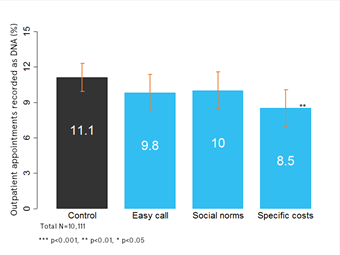
Thaler’s original test was in a Chicago school district where just by changing the presentation and layout of the food served, there was an increase of 35% in the consumption of healthy foods from students. Another example of this theory working is when a hospital worked with the Department of Health and Imperial College London to help reduce missed hospital appointments. The hospital would usually send SMS text reminders on the day, and then it changed the text messages to include the direct costs to the NHS for missing an appointment (£160). This helped to decrease missed appointments from 11.1% to 8.5%.
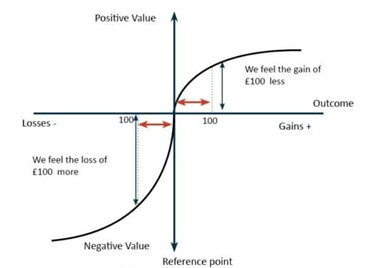
Another significant theory within Behavioural Economics is Prospect Theory. Prospect theory is an economic theory that describes how individuals make decisions based on expectations of loss or gain from their current relative position. It indicates that people are loss-averse, since individuals dislike losses more than the equivalent gain. The £100 loss in the diagram will be felt more than a gain of £100, this is illustrated by the negative value of the £100 loss being larger than the positive value from the £100 gain. A common expression to describe this theory is “losses loom larger than gains” (Daniel Kahneman and Amos Tversky). This has a clear distinction with the homo economicus assumption that would suggest the £100 loss would feel as bad as the utility gained from an additional £100. If people were rational, the feelings invoked by losing or gaining something (of equal value) would be equal.
Prospect theory emphasises how individuals may act irrationally by use of rules of thumb and the status quo bias. Status quo bias is an emotional preference for the current situation. Examples of this is choosing the default option. For example, studies show that opt-out consent leads to a relative increase in the total number of organ donations, which means that when the default position of consumers is to consent for organ donation, the end result of organ donations is higher than when the default position is to not donate.
This is because of the ‘endowment effect’. Behavioural economists such as Daniel Kahneman saw how in the real world, people became attached to their current situation and goods and give higher preference to what they already have. Some people wonder too much about the cost of making choices and therefore stay in the default option to prevent choosing the unknown despite this decision possibly not being the optimal decision. From Prospect theory firms may use past data from consumers to judge how to change their default positioning and/or presentation of choices to benefit their consumers.
However, in order to understand the basics of behavioural economics, we must also look at the possible arguments against the theories. One of the main arguments is whether there is ‘External Validity’. The main source of data for behavioural economists are laboratory experiments. The problem with lab experiments is that the choices in experiments may not correlate to real-world choices that consumers make. This means that the data lacks external validity.
For example, if in one experiment, data shows that 8/10 students chose to eat the green apple over the red apple. This may be different to the real-world choices; in the real world, it could be possible that more people choose red apples instead. This is because different people have different rules of thumb. The data from the experiment was not reliable and not valid. A study by researchers from University of British Columbia analysed the issue of how over-sampling of American college students may be damaging our understanding of human behaviour. They found that people from western, educated, industrialised, rich and democratic (WEIRD) societies represent around 80% of study participants but are only 12% of the world’s population. Most of the sampling done in studies are biased and not representative of humans as a species, they may be significantly unreliable.
Another issue with behavioural economics is the argument of data constraints and experimental design. The argument questions how researchers know if they have a reliable and representative sample from their data and how researchers cope with untruthful lazy answerers who simply click random options. Motivating and ensuring people to produce reliable data in experimental trials is a significant problem for economists and raises questions for whether the theories are worth using. Will government spending on nudge theories have a large enough effect on consumer decisions? Some argue that higher fuel taxes yield a better result than small nudges towards environmental decisions.
After looking at these basic ideas from and against behavioural economics, we may further read deeper into more complicated and developed ideas and understand the decisions that firms need to make when having to choose between spending on behavioural or conventional theories.
