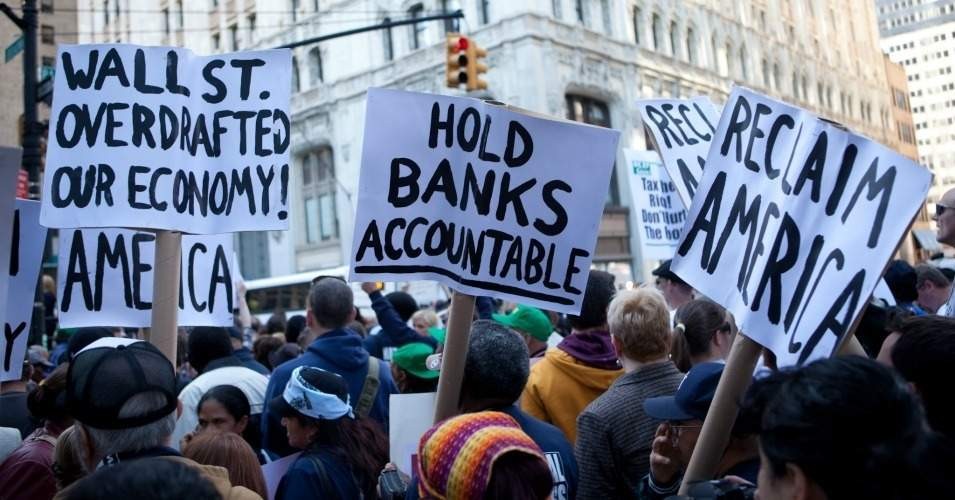
I am sure you have all heard about the financial crisis of 2008 and how it had massive effects on the world. And I am sure you have vaguely heard about the low interest rates that have followed ever since. Maybe starting to delve into this magazine, you’ll feel out of place when all of these complex terminologies are being thrown around, article to article, topic to topic. I was hoping to give you guys a little insight to the real meaning to all these terms so that the next time someone says ‘negative bond yield’ you can completely understand what it means and why this might be one of the safest ways of investing your money in this economic climate.
Let us start with the basics, what is a bank? A bank is a financial organisation that earns money by keeping the difference in the interest rates it charges its assets for lending money from it and the interest rates it pays its liabilities to save with them. Read that sentence again if you must. In essence it earns money by earning more money from its lenders than it does by spending on its creditors (people who save with a bank). Now when we say interest rates, what do we mean? The additional amount that the banks pay for saving money at the bank. For example, if the interest rate on a savings account is 2%, if you input £1000, into that account, after one year, you’d earn £20 interest on that £1000 pounds. It would work a similar way when borrowing, borrowing with a 2% interest rate on £1000, would mean that you must pay back an additional £20. But who decides the interest rates? The interest rates are seen as a lever by the government which they use to incentivise certain reactions in the economy. These banks borrow money from the national bank, The Bank of England. The Bank of England uses the economy as a means of stimulating economic growth with the sole principal that when interest rates are low, the cost of borrowing is low, so people have more incentive to spend more now, with a consequence of higher economic growth.
At this point in time, the bank of England is facing crisis as the interest rate has stayed at 0.5%(which is really low) since the financial crisis of 2008 and now that we are going into a recession due to decreased economic activity as a result of COVID 19 . The Bank of England may have to turn to quantitative easing which is the method by which the Bank of England prints more money and then buys assets from the government and the private sector as bonds or stocks in order to issue it with value. This money is then circulated in the economy increasing spending.
Nonetheless, what are the actual effects of commercial banks in an economy? Banks increase the money supply by increasing the amount of money in circulation without increasing the amount of physical cash moving around. This is done by loans. If a bank loans you £10,000 and you decide to invest that money in a bank by depositing that money elsewhere. The new bank keeps a percent of your deposit at the bank, allowing them to loan out the rest of the money. This acts as a cushion, if you were to withdraw some of your money. However, back to the remaining money, let us say £9,000; this £9,000 can be loaned out to another consumer. Within this very simple example, you can witness the magic of banking. An initial loan of £10,000 has created £19,000 in circulation as consumer 1 owes the first bank £10,000 and consumer 2 owes the second bank £9,000, meaning that total debt in the economy is now £19,000. This analogy can be further extended to the fact that deposits create loans, and this might be a very common saying.
However, even though there is a perception that deposits create loans, a bank is actually more than willing to give out a loan first as it also takes out a loan from the central bank or its other sources of incomes, including debt and equity financing.
But then why don’t banks lend out all their money and then borrow that from the central banks?
There is this idea of capital requirements which states the amount of capital a bank must hold relation to its lending. Capital can be thought of as the amount of profits that must be kept within a bank rather than distributed amongst the shareholders. Due to this, banks must be relatively safe from failing (except the financial crisis of 2008). These capital ratios were altered significantly in the wake of 2008.
The 2008 Financial crisis
The Financial crisis started with the mortgages - bank gets principal + interest every month as part of their loan repayment. Investors in the USA started throwing their money at the US housing market. They thought they would earn more money in interest by renting houses than by investing in US government bonds. This meant that banks would be giving out more mortgages to potential homebuyers.
Then investment banks saw opportunity for investors to make money so they bought the mortgages from these commercial banks and meant that they would repay the amount of the mortgage back to the bank with some extra fees so it is profitable for the banks. This was good for the banks as they then had more liquid assets which they could lend out money in the name of mortgages again and the cycle continues.
Investment banks pounced on the idea of selling mortgages as investment as they believed that their investors would love the low risk of it due to the fact that if the borrowers default on their debt, the investors get to keep the house and then end up selling the house in order to make their money back.
Now imagine this happening to millions of potential homeowners. Banks started giving out ‘subprime loans’: this means that they started providing loans to people with bad credit and low incomes even thought they had no means to pay it back. This did not matter to the bank as all these mortgages were being passed off to the investors anyway so even if they all defaulted, it would be the investors problem of selling and trying to retrieve their investment.
The investors were never informed of this risk and the organisations who were meant to assess the risks of mortgage-backed securities, classed them as very low risk investments so people kept investing. These mortgage-backed securities were the names of the shares of the mortgages provided by the investment banks to the public.
As the number and demand of mortgage-backed securities increases, commercial banks started making more securities, that were made of these unstable sub-prime mortgages. These homeowners were most likely to default on the mortgages. This meant that the banks would have to seize that house back and sell it in order to make their loaned amount back. However, as millions of these mortgages were issued, the supply for housing increased drastically and the demand for housing decreases. This meant that the price of houses fell substantially. This meant that investment banks couldn’t even make a complete return on their investments. If we look back to the idea of multiple credit creation which occurred due as a result of lending and borrowing, a significant reduction in the price of housing meant that the amount of credit that was made as a result of the borrowing and lending far exceeded the amount of physical cash in the economy. If the banks fail, all the credit created by them ceases to exist. People with pension savings in bank accounts soon find out that their accounts are empty as that money is also credit created by the bank, and hence doesn’t exist anymore. In addition to this, many commercial banks had investment bank divisions who also owned many shares of mortgage backed securities’ in terms of assets. When it was realised that these securities were worthless, the banks realised that they didn’t have enough assets to counter their liabilities. This is where the government stepped in and “bailed out the banks”, which meant they gave them liquid assets like cash, in order to rid them of their debt. In addition to that, the government guaranteed savings in banking deposits to up to £50,000. This was because if the bank users didn’t have confidence in the banks to return the money in their savings account, they would all rush to withdraw their savings from the banks, causing the banks to be drained of its assets. In addition to this, the banks didn’t have enough liquid assets to pay them anyway. This loss in consumer confidence in banks leading to them withdrawing all their money lead was known as the run on the banks.
A famous example of the run on the banks was Northern Rock. The situation with Northern Rock was special as instead of them using the assets (savings that consumers had deposited) in order to lend out to homeowners as mortgages, it decided to borrow from international markets. When the sub-prime crisis hit America, those markets took fright, and stopped lending to anything that looked like it might be over-exposed to the housing market. Northern Rock was an obvious first casualty. This meant that their assets which were the houses, lost a lot of its value and weren’t liquid forms of assets, and people lost confidence in the banks and decided to withdraw their savings causing the bank to become insolvent, yet the government decided to buy it out and nationalise it.